
Retirement income
Retirement income vs growth strategy
September 6, 2026
By Jamie Hargrave, Cadence Capital Investments
Retirement income vs growth strategy
Retirement income
Deciding on a retirement income vs growth strategy? Learn how these two approaches can work together to manage inflation and provide a dependable cash flow.
Choosing between a portfolio built for growth and one designed for income often feels like a fork in the road where you must pick one path and abandon the other. In practice most retirement portfolios use both, assigning each a role based on when the money will be spent.
This article compares what each approach does, why inflation and sequence of returns risk push in opposite directions, and how the two get balanced. It is educational and is not tax or legal advice. Consult your CPA or attorney about your situation.
Cadence Capital Investments is not affiliated with, endorsed by, or sponsored by Chevron Corporation.
• Growth addresses the erosion of purchasing power over a long retirement; income addresses near-term spending.
• Sequence of returns risk is the reason near-term spending is generally not funded from volatile assets.
• A segmented approach assigns assets to time horizons; it organizes decisions rather than removing risk.
• Neither approach eliminates the possibility of loss.
• Cadence Capital Investments is fee-based, not fee-only.
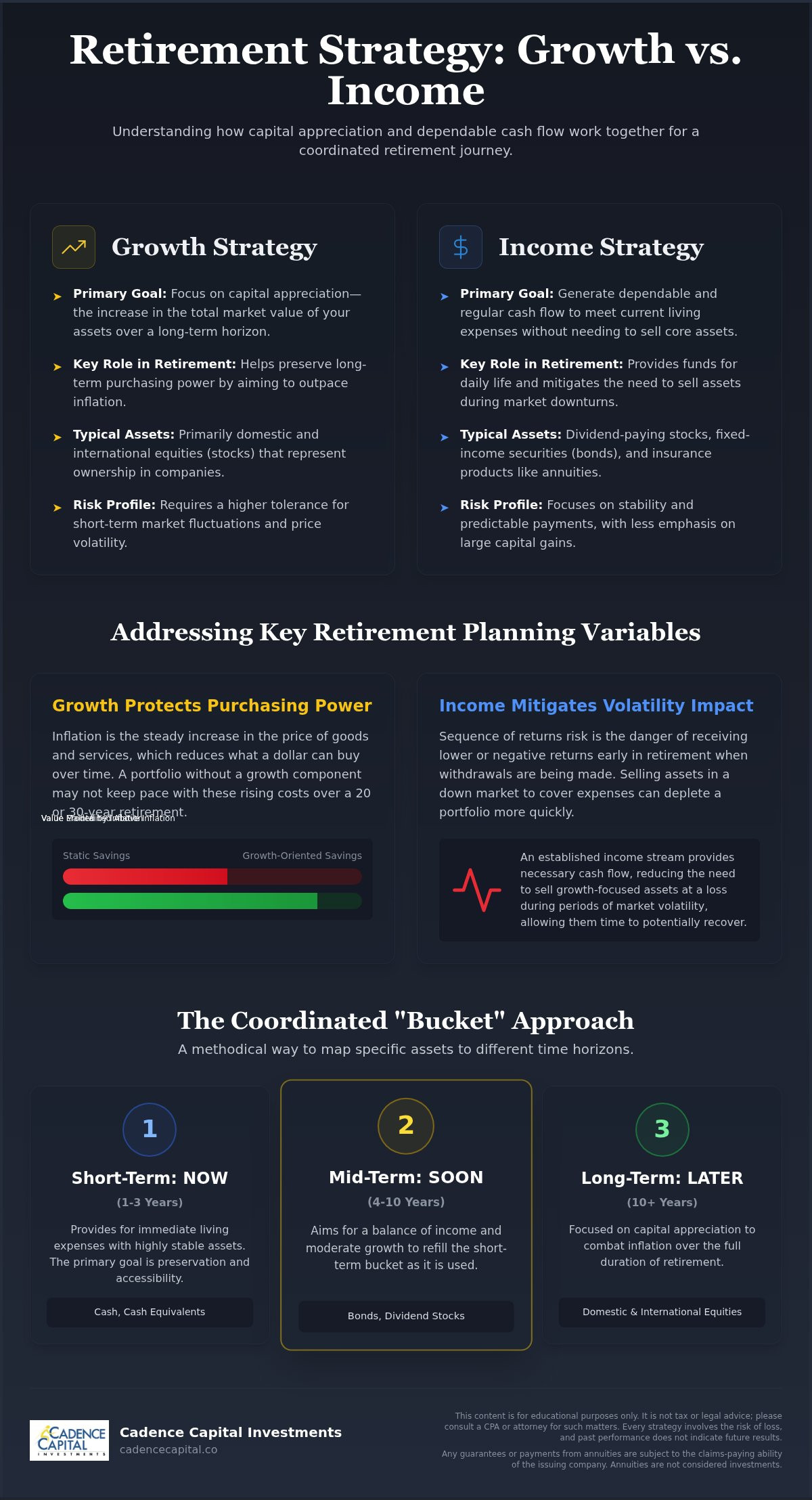
A growth strategy pursues capital appreciation, meaning an increase in the market value of holdings over a long horizon. It typically uses domestic and international equities, which represent ownership in companies and carry meaningful short-term price fluctuation.
An income strategy produces regular cash flow to meet living expenses, often through dividends, interest from fixed income securities, or in some cases insurance contracts structured to make payments.
The shift from accumulation to distribution is what makes the balance between them a live question. During working years the objective was growing a balance. In retirement the objective is funding spending across an unknown number of years, and those require different structures.
All investing involves the risk of loss, and past performance is not indicative of future results.
A retirement lasting twenty or thirty years faces rising costs across housing, healthcare, and everyday expenses. A portfolio held entirely in stable assets may not keep pace with those increases, which is a slow risk rather than a dramatic one but a real one.
Equities allow participation in broader economic activity over long periods. That participation comes with volatility and with the risk of loss, and no historical pattern guarantees future results. What a plan can do is size the growth allocation to the portion of spending that is far enough out to absorb fluctuation.
Social Security does adjust for inflation; beneficiaries received a 2.8 percent cost-of-living adjustment for 2026, per SSA.gov. Most pension and annuity payments do not adjust unless the contract provides for it, which is what leaves the gap growth assets are asked to address.
Rebalancing means periodically returning the portfolio toward its target allocation, which generally involves trimming what has grown and adding to what has not. It is a discipline for keeping risk where it was intended to be rather than a method for improving returns.
When a paycheck stops, the portfolio takes over that function. The relevant measure changes from total value to usable cash flow, and the risk changes with it.
Sequence of returns risk is the danger of poor returns arriving early in retirement while withdrawals are being taken. Selling during a decline means selling more shares to raise the same amount of cash, leaving fewer shares to participate in any recovery. Two portfolios with identical average returns can produce very different outcomes depending on the order in which those returns arrive.
An income component, or a cash reserve, reduces the need to sell depressed assets to fund near-term spending. That is the mechanism, and it is a meaningful one, though it does not remove market risk from the portfolio as a whole.
Cash flow can come from dividend-paying equities, from a bond ladder (a series of bonds maturing at staggered intervals so that principal becomes available on a schedule), from cash reserves, and in some cases from insurance contracts.
Annuities are insurance contracts rather than investments, and any guarantees or payments are subject to the claims-paying ability of the issuing company. They carry fees, expenses, and surrender terms that warrant detailed review. Insurance and annuity products are offered through licensed affiliates and agents, and an affiliate may earn a commission, which is disclosed before any recommendation.
A segmented or bucket framework assigns assets to time horizons. Near-term spending is held in cash and stable holdings; the middle years use assets with moderate fluctuation; the long horizon holds growth assets.
The purpose is to make explicit which assets fund which period, so that a decline in growth assets does not force a sale to cover next month's expenses. It is a way of organizing decisions. It does not eliminate market risk, and the specific time bands vary by situation.
The balance is not fixed. Early retirement often involves higher discretionary spending and an active lifestyle; later years shift toward healthcare. Keeping a growth component into the later years addresses purchasing power over the full horizon rather than only the first decade.
We meet quarterly to review withdrawals against actual spending and to adjust the allocation as circumstances change.
Insurance addresses risks the portfolio does not, including long-term care costs and income replacement for a surviving spouse. Coordinating protection with the investment plan avoids both gaps and redundant cost.
Households transitioning out of long corporate careers in the East Bay frequently hold a significant share of their wealth inside employer plans, which makes several plan decisions part of the portfolio conversation rather than separate from it.
Cadence Capital Investments is not affiliated with, endorsed by, or sponsored by Chevron Corporation. Plan provisions change; confirm current terms with your plan administrator and your summary plan description.
Net Unrealized Appreciation. Where appreciated employer stock sits in the plan, an NUA election applies ordinary income treatment to the cost basis, with the appreciation taxed at long-term capital gains rates when the shares are sold. It requires a lump sum distribution of the entire vested balance within one tax year and an in-kind transfer of the shares to a taxable account. Tax on the basis is due in the year of transfer, and the election is generally irreversible. It also leaves a concentrated position, which is a portfolio question as much as a tax one.
Separation at or after age 55. Where you separate from service in or after the calendar year you turn 55, distributions from that employer's qualified plan may avoid the additional 10 percent early distribution tax. Ordinary income tax still applies, and the relief does not extend to IRAs or to plans of previous employers.
This is educational and is not tax advice; consult your CPA before any election.
Investment advisory services at Cadence Capital Investments are offered through Prosperity Financial, a Registered Investment Advisor, which acts in a fiduciary capacity with respect to the advisory services it provides. Securities are offered through Fortune Financial Services, LLC, a Registered Broker/Dealer and member FINRA and SIPC; brokerage recommendations are subject to Regulation Best Interest. Insurance and annuity products are offered through licensed affiliates and agents, which means the firm is fee-based rather than fee-only.
Because an affiliate may earn commissions on certain products, a conflict of interest exists. We manage it by disclosing the compensation applicable to any recommendation before it is made and by describing the structure in our Form CRS.
Growth pursues appreciation in the market value of holdings over long periods and accepts short-term fluctuation to do it. Income produces regular cash flow through dividends, interest, or contractual payments. They address different problems: growth addresses purchasing power over decades, income addresses spending now.
Most retirement portfolios do. A segmented approach assigns near-term spending to stable assets and the long horizon to growth assets, so that a decline does not force a sale to cover current expenses. Where the line sits between the two depends on your spending, your other income sources, and your tolerance for fluctuation.
It reduces what a fixed payment buys. Social Security adjusts annually; beneficiaries received a 2.8 percent cost-of-living adjustment for 2026, per SSA.gov. Most pension and annuity payments do not adjust unless the contract provides for it, which is the gap a growth allocation is usually asked to address.
The risk that poor returns arrive early in retirement while withdrawals are being taken. Selling into a decline means liquidating more shares for the same cash, leaving fewer to participate in a recovery. Holding near-term spending in stable assets reduces the need to do that, though it does not remove market risk from the portfolio overall.
Generally yes. Interest and non-qualified dividends are typically taxed as ordinary income; qualified dividends and gains on assets held more than a year are taxed at long-term capital gains rates. The 3.8 percent Net Investment Income Tax may apply above statutory income thresholds. Which account type holds which asset also matters. This is not tax advice; consult your CPA.
By comparing what the portfolio would have to sell in a down year against what is held in stable assets. If funding a year of spending would require selling growth assets during a decline, the near-term allocation is probably too small. That is the specific question worth asking, rather than a general judgment about whether the portfolio is aggressive.
Yes, as an independent firm. Cadence Capital Investments is not affiliated with, endorsed by, or sponsored by Chevron Corporation, and nothing here is an employer-approved benefits resource. We work through pension elections, savings plan distributions, and company stock decisions as part of the wider portfolio and income plan.
This article is for general informational and educational purposes only. It is not individualized investment, tax, or legal advice, is not a recommendation to buy, sell, or hold any security or insurance product, and does not account for your specific circumstances. Consult your CPA or attorney regarding your individual tax and legal situation. Investing involves risk, including the possible loss of principal. Past performance is not indicative of future results.
Tax rules, benefit figures, and age triggers are stated as of the publication date and are subject to legislative and regulatory change; IRS.gov and SSA.gov publish current figures. Descriptions of employer benefit plans are general; confirm all plan provisions with your plan administrator and your summary plan description before making any election.
Advisory services offered through Prosperity Financial, a Registered Investment Advisor. Securities offered through Fortune Financial Services, LLC, a Registered Broker/Dealer, member FINRA / SIPC. Insurance and annuity products are offered through licensed affiliates and agents; product guarantees are subject to the claims-paying ability of the issuing company. Because an affiliate may earn commissions on certain products, Cadence Capital Investments is fee-based rather than fee-only.
Cadence Capital Investments is not affiliated with, endorsed by, or sponsored by Chevron Corporation or any other employer, plan sponsor, plan administrator, or government agency named in this article. All company, plan, and product names are the property of their respective owners and are used for identification purposes only. Nothing in this article is a comparison to, or an assessment of, any other advisory firm.
We value your privacy, and we want to help make your experience with Cadence Capital Investments as satisfying and safe as possible. We have established this Privacy Policy to explain how we receive, use, and share information you may provide in connection with your access to this website.
The Site is intended for use only by individuals over the age of 18 who are accessing the Site from inside the United States. By using the Site or submitting any information to us, you acknowledge that you are over the age of 18, are in the United States, and that you consent to our use and sharing of information collected or submitted as described in this Privacy Policy. This Privacy Policy is incorporated into and is subject to the Site's Terms of Use. By using the Site, you expressly consent to the terms of this Privacy Policy and the information handling practices described herein.
In connection with your use of this Site, we may collect both personally identifiable information ("PII") and non-personally identifiable information ("Non-PII"). PII includes information such as your name, address, phone number, zip code, email address, and similar information. Non-PII may include, for example, your IP address, browser type, domain names, access dates, and similar information. (PII and Non-PII are collectively referred to as "Information.")
We may collect information from you through your voluntary submission to receive offers from the Site or access to certain resources on the Site. We also may collect information from your browser when you use the Site, using a variety of methods. The information collected by these automated methods may include, for example, your IP address, cookie information, a unique device or user ID, browser type, system type, the content and pages that you access on the Site, and the referring URL (the page from which you navigated to the Site). We may use cookies on the Site to recognize you and to store references to you and session validators on your device. We may use passively-collected information to administer, operate, and improve the Site and our other services, and to provide content tailored to you. We may combine Non-PII with PII.
If we directly combine any Non-PII with PII, we treat the combined information as PII under this Privacy Policy. Otherwise, we use information collected by passive means in aggregated or other non-personally identifiable forms.
We may use the information you provide for any purpose, including but not limited to: (1) providing materials you have requested; (2) contacting you regarding the potential purchase of insurance or other financial products; (3) personalizing our contact with you; (4) operating, providing, improving, and maintaining the Site; (5) developing new products and services; (6) preventing abusive and fraudulent use of the Site; and (7) sending administrative messages, content, and other features we believe may interest you, and for other administrative and internal business purposes permitted by law.
We may share your information with third parties who assist us in operating our business and servicing our clients. We may also disclose Information if, in good faith, we believe doing so is required by a subpoena or other judicial or administrative order, or otherwise required by law. We may disclose Information if we deem it appropriate or necessary to prevent violation of the Site's Terms of Use or our other agreements; take precautions against liability; protect our rights, property, or safety, or those of any individual or the general public; maintain the security and integrity of our services or infrastructure; protect ourselves from fraudulent, abusive, or unlawful uses; investigate and defend against third-party claims; or assist government enforcement agencies.
Your provision of information to us through the website will be considered a grant of permission for us to contact you through any means provided (including but not limited to mail, phone, text message, and fax). You have the right to opt out of further promotional contact from us. To be removed from an email mailing list, please send your request to contact@lonebeacon.com or to 2333 San Ramon Valley Blvd, Suite 200, San Ramon, CA 94583. It may take up to 10 days to process your request. This opt-out applies only to future promotional messages; we may still send administrative messages as permitted by law.
We maintain a variety of security measures to protect against the loss, misuse, and alteration of Information under our control. Although we make good faith efforts to maintain the security of such Information, we cannot guarantee that it will remain free from unauthorized access, use, disclosure, or alteration, and we cannot guarantee that our security measures will prevent unauthorized persons from accessing this information. We assume no liability to you or any other party in relation to the unauthorized access, use, or alteration of any information provided to us.
If we become aware of a security breach, we may attempt to notify you electronically so that you can take appropriate protective steps. By using the Site or providing Information to us, you agree that we may communicate with you electronically regarding security, privacy, and administrative issues relating to your use of the Site. If you believe there has been a breach of the Site's security, please contact us at (925) 314-8513.
We may update or amend this Privacy Policy at any time. No prior notice of any update or amendment is required, and all updates are effective upon being posted. We encourage you to periodically review this Privacy Policy. Your continued use of the Site constitutes your agreement to this Privacy Policy and any updates.
If you have questions about this Privacy Policy, you may contact us at (925) 314-8513.
All information available through this website is the property of Cadence Capital Investments (the "Company") or its Information Providers and is protected by copyright and intellectual property laws. All rights reserved.
You may not reproduce, retransmit, disseminate, sell, publish, or broadcast the information, nor use it in connection with creating, promoting, trading, or marketing financial instruments or products, without the express written consent of the Company or its licensors. You are entitled to use the information it contains for your private, non-commercial use only.
Cadence Capital Investments operates this website (the "website") to provide information, related features, and services (the "Service"). The terms and conditions set forth herein (the "Terms of Use") constitute a legally binding agreement between the Company and you regarding the terms on which the Company offers you access to the Service. By accessing and using this website, you agree to be bound by these Terms of Use and all applicable laws and regulations. If you do not agree, you are not authorized to access or use this website for any purpose.
The information provided on this website is not intended for distribution to, or use by, any person or entity in any jurisdiction or country where such distribution or use would be contrary to law or regulation, or which would subject the Company to any registration requirement within such jurisdiction or country. Neither the information nor any opinion contained in this website constitutes a solicitation or offer by the Company to buy or sell any securities, futures, options, or other financial instruments, or provide any investment advice or service.
The Company reserves the right to modify these Terms of Use at any time without giving you prior notice. Your use of the website following any such modification constitutes your agreement to follow and be bound by the Terms of Use as modified. We encourage you to review these Terms of Use whenever you use this website.
The Service, the website, and all data, information, and content that you see, hear, or otherwise experience on the website (the "Content") belong to the Company, its partners, affiliates, contributors, or third parties, and may be protected by U.S. and international copyright, trademark, intellectual property, and other laws. Content provided by third parties is used with their permission.
You may download, print, and store selected portions of the Content, provided that you (1) do not copy or post the Content on any network computer or transmit, distribute, publish, or broadcast the Content in any media, including a website; and (2) do not modify or alter the Content in any way, or delete or change any copyright or trademark notice. No right, title, or interest in any copied or downloaded Content is transferred to you. You may not use any of the marks appearing throughout this website without express written consent from the trademark owner, except as permitted by applicable law.
The information on this website is provided "as is." You expressly agree to assume total responsibility and risk for your use of the website and the Service. The Company makes no express or implied warranties, representations, or endorsements whatsoever with respect to the website or the Service, and expressly disclaims all warranties of any kind, express, implied, statutory, or otherwise, including implied warranties of merchantability, fitness for a particular purpose, title, and noninfringement. The Company does not warrant that the functions performed by the website or the Service will be uninterrupted, timely, secure, or error-free, or that defects will be corrected. The website, the Service, and the Content are provided on an "as is" and "as available" basis.
If you are dissatisfied with the website, any Content, or the Terms of Use, your sole and exclusive remedy is to discontinue using the website. Under no circumstances will the Company be liable for any damages whatsoever, including direct, incidental, consequential, exemplary, or indirect damages arising out of the use of or inability to use the website, the Service, or the Content. Because some states do not allow the exclusion or limitation of liability for consequential or incidental damages, some of the above limitations may not apply to you.
For details on how we handle personal information, please see our Privacy Policy.
You agree not to take any action that interferes with the proper working of the website; imposes an unreasonable or disproportionately large load on the website's infrastructure; might compromise the security of the website; renders the website or the Service inaccessible to others; or otherwise causes damage to the website or any Content. You agree not to add to, subtract from, or otherwise modify the Content except as expressly authorized by the Company in these Terms of Use or by a written agreement between you and the Company.
Entire agreement. These Terms of Use constitute the entire agreement of the parties with respect to the subject matter hereof and supersede all previous written or oral agreements. No waiver by the Company of any breach or default shall be deemed a waiver of any preceding or subsequent breach or default.
Correction of errors and inaccuracies. The information on the website may contain typographical or other errors or inaccuracies and may not be complete or current. We reserve the right to correct any errors, inaccuracies, or omissions and to change or update information at any time without prior notice. We do not, however, guarantee that any errors will be corrected.
No endorsements of links. Hypertext links to third-party websites or information do not constitute or imply an endorsement, sponsorship, or recommendation by the Company. You acknowledge that the Company is not responsible for the availability of any such websites and does not endorse or warrant, and is not responsible or liable for, any such website or its content. Links to other sites are provided for convenience only.
Enforcement. If any part of these Terms of Use is determined to be invalid or unenforceable, it will not impact any other provision, all of which will remain in full force and effect. These Terms of Use are governed by, and will be interpreted in accordance with, the laws of the State of California, without regard to conflict of laws provisions. You consent to the exclusive jurisdiction and venue of courts in California, U.S.A., regarding any disputes relating to these Terms of Use, the Company's Privacy Statement, your use of the website, the Service, or Content contained therein.
The content is developed from sources believed to be providing accurate information. The information in this material is not intended as tax or legal advice. Please consult legal or tax professionals for specific information regarding your individual situation. The opinions expressed and material provided are for general information and should not be considered a solicitation for the purchase or sale of any security.
Cadence Capital Investments is not affiliated with, endorsed by, or sponsored by Chevron Corporation, AT&T Inc., or Toyota Motor North America, Inc. Company names and benefit plan names, including the Chevron Employee Savings Investment Plan, the Chevron Retirement Plan, the AT&T Pension Benefit Plan, the AT&T Retirement Savings Plan, the AT&T Savings and Security Plan, the Toyota Motor North America, Inc. Retirement Savings Plan, and the Toyota Motor Sales, U.S.A., Inc. Pension Plan, are trademarks or plan names of their respective owners and are used on this site for identification and educational purposes only. Benefit plan provisions and IRS limits change and vary by individual circumstance; confirm current details with your employer's plan documents and plan administrator before acting.
We take protecting your data and privacy very seriously. As of January 1, 2020, the California Consumer Privacy Act (CCPA) suggests the following link as an extra measure to safeguard your data: Do not sell my personal information.