
Employer benefits
Chevron 401k Rollover Options: A Reference to Destinations and Fees
October 20, 2026
By Jamie Hargrave, Cadence Capital Investments
Chevron 401k Rollover Options: A Reference to Destinations and Fees
Employer benefits
Review Chevron 401k rollover options. Compare the Chevron ESIP, IRAs, investment fees, and tax rules before moving your East Bay retirement savings.
Chevron 401(k) rollover options generally include leaving eligible savings in the Chevron Employee Savings Investment Plan, moving them to an IRA, or transferring them to a new employer’s plan that accepts them. The right destination depends on the account’s tax sources, investment choices, fees, and distribution features, so compare the plan terms before initiating a transfer.
• Sort pre-tax, after-tax, and Roth assets before choosing where each portion should go.
• Compare a traditional IRA rollover with the plan’s available options, including how earnings on after-tax contributions may be treated.
• Weigh investment choices, administrative fees, and investment expenses together when comparing destinations.
• Leaving savings in the current plan may preserve plan-specific features, so include that route in your comparison.
• Understand the steps for a direct rollover and the tax treatment of distributions before moving or withdrawing retirement savings.
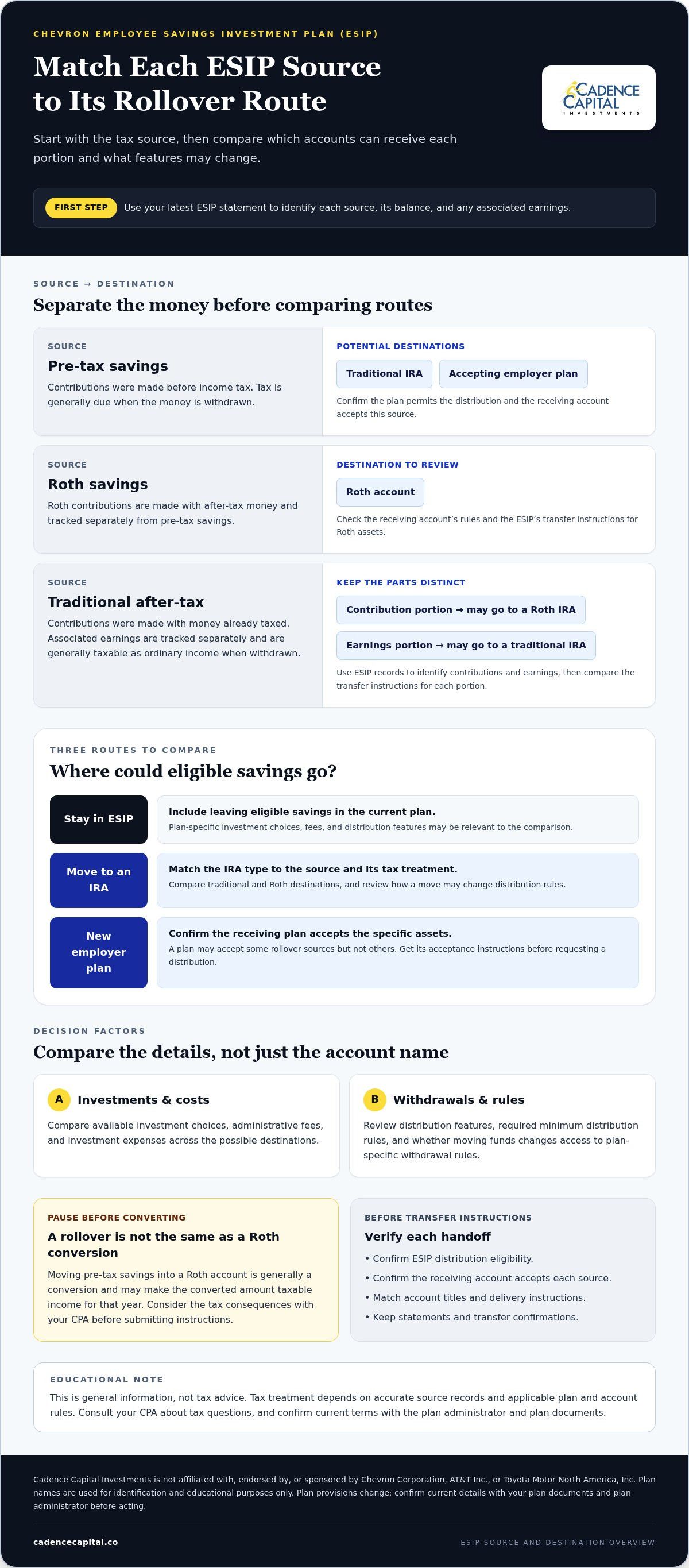
Pre-tax contributions are retirement savings made before income tax, with tax generally due when withdrawn. Traditional after-tax contributions are made with money already taxed, while their earnings grow tax-deferred and are generally taxable as ordinary income when withdrawn. Roth contributions are made with after-tax money and are tracked separately from pre-tax savings. Before comparing Chevron 401k rollover options, use your latest Chevron Employee Savings Investment Plan (ESIP) statement to identify each source and its balance. This record helps match assets to destinations according to their tax treatment.
Separate ESIP savings into pre-tax, traditional after-tax, and Roth sources, then note any associated earnings shown in plan records. Eligible pre-tax assets may move to a traditional IRA or another employer plan that accepts them. Roth assets generally need a Roth destination. After-tax contributions and earnings may require different instructions: contributions may move to a Roth IRA, while earnings may move to a traditional IRA. Keeping these amounts separate matters because principal and earnings can receive different tax treatment.
A Roth conversion moves money from a traditional tax-deferred account into a Roth account, generally making the converted amount taxable income. This differs from a rollover that preserves the account’s tax character. For example, moving pre-tax ESIP savings into a Roth account may affect your taxable income for the year of conversion. Consider the amount alongside other income, and consult your CPA about the tax consequences. This article provides general information, not tax advice.
Roth catch-up contributions are additional plan contributions directed to a Roth account under applicable plan terms. If you are eligible to make catch-up contributions, review the ESIP’s current instructions to understand which tax source applies. This election concerns future contributions, not the classification of existing assets. Keep election confirmations with your ESIP records so future deposits remain distinguishable from earlier pre-tax and after-tax balances.
A trustee-to-trustee transfer moves IRA assets directly between trustees without the account owner receiving the funds. According to the Internal Revenue Service, trustee-to-trustee transfers between IRAs are not subject to the one-per-12-month rollover restriction. Compare Chevron 401k rollover options by listing each source, its intended destination, and the transfer method. Retain statements and transfer confirmations with your tax records, and discuss tax questions with your CPA before submitting instructions.
Eligibility depends on whether the Chevron Employee Savings Investment Plan (ESIP) permits a distribution and whether the destination accepts the assets; for an IRA-to-IRA rollover you receive, the Internal Revenue Service generally requires redeposit within 60 days, subject to change. Outstanding loan balances and Chevron shares follow plan and distribution rules, so review their treatment before selecting a destination.
A contribution-and-earnings rollover directs after-tax contribution principal and its earnings according to their separate tax records. Use ESIP records to identify the contributions and associated growth, then follow the transfer instructions for each portion.
For example, if your statement lists after-tax contributions and associated earnings separately, specify the intended destination for each amount. The contribution portion may go to a Roth IRA, while earnings may go to a traditional IRA. Before authorizing the transfer, compare the plan’s source records with the receiving custodian’s instructions. Keep statements and confirmations to document how each portion was processed. Because tax treatment can depend on accurate classification, discuss the transaction with your CPA. This is general information, not tax advice.
An IRA or new 401(k) destination is an account that receives eligible savings from the ESIP. A traditional IRA, Roth IRA, or accepting employer plan may serve as a destination, depending on the asset’s tax source and the receiving account’s rules.
Ask the receiving institution for its exact account title, delivery instructions, and documentation requirements. Compare those details with the ESIP’s distribution forms. A new employer’s plan may accept some rollover assets but not others, so confirm which sources it can receive before requesting a distribution. Keep written acceptance instructions with your records. These steps can help prevent a transfer from being misdirected or processed as a payment to you.
Rollover eligibility means the ESIP permits the requested distribution and the receiving account accepts that type of asset. The summary plan description and administrator’s distribution instructions explain the process.
For an IRA-to-IRA rollover where you receive the funds, the 60-day redeposit deadline is different from a direct trustee transfer. The Internal Revenue Service generally applies that deadline to the distribution, subject to change. For a Chevron stock position, record the shares, their tax basis information, and how the distribution will occur before choosing a route. A loan balance is not transferred like ordinary investments; its handling depends on plan terms. Chevron employees considering plan-specific decisions can use Chevron retirement planning to organize these questions.
Compare available investments, account fees, and withdrawal features before choosing where ESIP savings should go. Required minimum distributions (RMDs) are withdrawals required from certain retirement accounts; a rollover can change which account’s distribution rules apply. The age-55 exception may allow penalty-tax treatment for some employer-plan withdrawals after separation from service, but rolling assets to an IRA can change access to that exception. Review both points before moving funds.
Investment options are the investments available within a particular account. Compare the ESIP menu, an IRA’s available investments, and a new employer plan’s options by reviewing each account’s investment list and fee disclosures. Consider how each option fits your intended asset mix, not just its name. Also check whether the account can hold shares or other assets you intend to retain.
Account fees are charges for maintaining or using an account, while investment expenses relate to specific holdings. Review plan administration charges, investment-level expenses, and any transaction charges in the relevant disclosures. Consider how fees paid from the account affect its balance over time. Compare similar investments: a broad fund in the ESIP and a comparable IRA investment may have different expense structures.
BrokerageLink is a brokerage window within a retirement plan that may offer access to investments beyond its standard menu. If it is available in the ESIP, permitted investments, restrictions, transaction charges, and account costs depend on plan terms. Read the BrokerageLink disclosure and compare its full costs with the standard ESIP options. A wider menu alone does not mean the window suits your investment approach.
A brokerage window is a plan feature that lets participants select from an expanded range of investments through a brokerage account. Before using one, identify permitted holdings, trading restrictions, and how transaction and ongoing expenses are charged. Understand how the window affects recordkeeping and investment oversight. For example, compare the total cost of holding a particular fund in the window with an available plan-menu alternative.
Vested savings are plan benefits that belong to the participant under the plan’s vesting rules. Before comparing rollover destinations, separate vested amounts from any balance still subject to vesting. Then compare access, investment choices, fees, and tax treatment for the vested portion. This distinction can affect how much is eligible to move and which options apply.
RMD rules require account owners to take applicable distributions under federal law. A rollover can change the account from which future RMDs are calculated, so include distribution timing in the comparison. The age-55 exception concerns certain withdrawals from an employer plan after qualifying separation from service; it does not automatically carry over to an IRA. Confirm the applicable rules with the plan administrator and consult a tax professional. Tax rules can change.
Leaving savings in the Chevron Employee Savings Investment Plan (ESIP) means keeping eligible retirement savings in the existing employer plan after separation. Fees and restrictions depend on plan terms and account activity. Compare the ESIP’s fee disclosures and distribution rules with those of other destinations before deciding.
Plan and provider information identifies the ESIP, its administrator, and the records explaining its features. Use your latest ESIP statement and summary plan description to find the administrator’s contact details, distribution procedures, and investment information. Keep these documents with rollover confirmations and fee disclosures.
The Chevron Employee Savings Investment Plan is separate from the Chevron Retirement Plan, which is a pension. For questions about an ESIP account, use the ESIP administrator and plan documents rather than pension materials. This distinction helps you find the rules that apply to your balance, investment options, and access after leaving employment.
Keeping savings in the plan preserves the account within the ESIP instead of transferring it to an IRA or another employer plan. Compare the existing plan’s investment menu, administrative charges, and distribution features with the alternatives you are considering. Also note whether the balance includes company shares or different contribution sources, since those assets can involve different considerations.
No single fee or restriction applies to every rollover decision. Separate charges for maintaining the ESIP account from transaction-specific charges, then review the plan’s distribution instructions for restrictions. For example, compare the ESIP’s ongoing expenses with the fees and investment expenses of a proposed destination before moving the assets.
Leaving assets in the ESIP may preserve plan-specific access that could change after a rollover. This may matter if your retirement savings decision involves planned withdrawals, company shares, or coordination with other income. A rollover can be difficult to reverse once completed, particularly if assets enter an account with different tax treatment or distribution rules. Record the account balance, holdings, and intended use before giving transfer instructions.
To compare your options, list the ESIP features you would retain, the expenses you would continue paying, and the features offered by each destination. Include expected retirement withdrawals and other income. If keeping the account supports your plan and its terms fit your needs, leaving the balance in place is an option to weigh alongside a rollover.
A taxable distribution is retirement money paid to you that may be included in taxable income. To avoid turning a workplace-plan transfer into a personal withdrawal, identify whether the movement is a direct rollover, an IRA rollover, or a cash distribution. Follow the correct process for that account type and keep the transfer records with your tax documents.
A direct rollover sends eligible ESIP funds to another retirement account without paying the money to you. Before initiating one, confirm the destination account’s registration details and the plan’s instructions. Make sure the receiving account can accept each asset source. A correctly completed direct rollover can move workplace savings without current tax. Keep the distribution statement and receiving-account confirmation to document where the funds went.
An IRA-to-IRA rollover occurs when an IRA owner receives a distribution from one IRA and redeposits it into another IRA. According to the Internal Revenue Service, the owner generally must redeposit the distribution within 60 days; this rule is subject to change. The Internal Revenue Service also generally limits IRA-to-IRA rollovers to one per 12 months; that rule is subject to change. These limits concern IRA distributions and rollovers, not every movement between retirement accounts.
An early-withdrawal penalty tax is a federal tax that may apply to certain withdrawals before retirement. The Internal Revenue Service says early withdrawals from Chevron ESIP before-tax accounts may be subject to a 10 percent federal penalty tax. The penalty is separate from ordinary income tax that may apply to a taxable distribution. Before requesting funds personally, identify the account source and intended use, then review the tax consequences with your CPA.
A Roth conversion moves pre-tax retirement money into a Roth account and generally makes the converted amount taxable income. It differs from a direct rollover that preserves the money’s tax character. For example, moving pre-tax ESIP savings into a Roth IRA is not simply a tax-free account change. Consider the conversion amount alongside other income for the tax year, and consult your CPA before making the election. This information is educational, not tax advice.
A distribution record documents the amount paid, the account source, and where the funds were deposited. Save the ESIP statement, transaction confirmation, and tax forms together. If a check is issued to you instead of directly to a receiving account, determine whether it is an IRA rollover or another type of distribution before acting. The account type affects the applicable deadline and reporting.
For a tax-sensitive ESIP transfer, write down the source, destination, transfer method, and intended tax treatment before submitting instructions. This record can help you and your CPA review whether the transfer was processed as intended.
Cadence Capital Investments helps Chevron employees and retirees consider ESIP decisions within their broader retirement plans through Financial Advisor & Planning and Chevron Employee Retirement Consulting. This support can be useful when comparing an ESIP rollover with leaving savings in the plan, especially when investment choices, company shares, and future income need to be considered together.
Investment Management and Retirement Income Planning can connect portfolio decisions with how you expect to use savings in retirement. A discussion can cover questions to resolve before submitting rollover instructions, including which assets to move, where to send them, and how the decision fits your broader plan. Cadence Capital Investments provides independent planning services and is not affiliated with, endorsed by, or sponsored by Chevron Corporation.
To discuss your situation, contact Cadence Capital Investments or visit cadencecapital.co.
A rollover can shape how you manage retirement assets for years, so consider it as part of a broader plan rather than an isolated account change. Before acting, write down the decision, the information supporting it, and how it fits your expected income needs. Some transfers may be difficult to reverse once completed.
A careful review of your Chevron 401k rollover options can help connect account decisions with your wider financial picture. Cadence Capital Investments offers Financial Advisor & Planning, Chevron Employee Retirement Consulting, and Investment Management for people coordinating these choices. The right next step may be a review of how the account fits with your other retirement resources and planned withdrawals.
This article is educational and not investment, tax, or legal advice. Investments involve risk, including possible loss of principal. Consult your CPA or attorney about tax or legal questions. Cadence Capital Investments is not affiliated with, endorsed by, or sponsored by Chevron Corporation.
Contact Cadence Capital Investments to discuss a thoughtful next step for your retirement planning.
Available choices depend on your employment status and the Chevron Employee Savings Investment Plan’s distribution terms. A former employee may compare keeping eligible savings in the plan, rolling eligible assets to an IRA, or transferring them to a new employer’s plan that accepts them. A current employee’s access may differ. Review the plan’s distribution rules and account sources to determine which options apply.
Yes, eligible Chevron ESIP savings may be rolled to an IRA or another employer’s plan that accepts the assets. For example, if you start a new job, compare the receiving plan’s investment choices and rules with an IRA’s features. Confirm which asset types the receiving plan accepts, then coordinate its instructions with the ESIP distribution process before starting the transfer.
Tax treatment depends on each balance’s source and destination. Pre-tax savings generally retain tax-deferred treatment when moved to a traditional IRA or eligible employer plan; Roth savings generally need a Roth destination. After-tax contributions and their earnings may receive different treatment. Moving pre-tax savings to a Roth account is a conversion and can create taxable income. This is not tax advice; consult your CPA.
Compare each account’s investment menu, administrative charges, fund expenses, and transaction costs. An ESIP option, for instance, may have a different expense structure from a similar investment in an IRA or new employer plan. If BrokerageLink is available, include its permitted investments, restrictions, and charges. Review current disclosures side by side, since an account’s name alone does not show its total costs or investment fit.
Cashing out can make some or all of the payment taxable income, and an early distribution may also face a federal penalty tax. The money leaves its retirement account, removing its tax-advantaged treatment and reducing savings available for future retirement needs. Before choosing cash, consider the amount needed now, other available income, and the tax effect with your CPA.
Outstanding loans are not transferred like ordinary investments; their treatment depends on the plan’s terms. Chevron shares are subject to distribution rules, so record the shares and their tax basis and confirm how they will be distributed.

We value your privacy, and we want to help make your experience with Cadence Capital Investments as satisfying and safe as possible. We have established this Privacy Policy to explain how we receive, use, and share information you may provide in connection with your access to this website.
The Site is intended for use only by individuals over the age of 18 who are accessing the Site from inside the United States. By using the Site or submitting any information to us, you acknowledge that you are over the age of 18, are in the United States, and that you consent to our use and sharing of information collected or submitted as described in this Privacy Policy. This Privacy Policy is incorporated into and is subject to the Site's Terms of Use. By using the Site, you expressly consent to the terms of this Privacy Policy and the information handling practices described herein.
In connection with your use of this Site, we may collect both personally identifiable information ("PII") and non-personally identifiable information ("Non-PII"). PII includes information such as your name, address, phone number, zip code, email address, and similar information. Non-PII may include, for example, your IP address, browser type, domain names, access dates, and similar information. (PII and Non-PII are collectively referred to as "Information.")
We may collect information from you through your voluntary submission to receive offers from the Site or access to certain resources on the Site. We also may collect information from your browser when you use the Site, using a variety of methods. The information collected by these automated methods may include, for example, your IP address, cookie information, a unique device or user ID, browser type, system type, the content and pages that you access on the Site, and the referring URL (the page from which you navigated to the Site). We may use cookies on the Site to recognize you and to store references to you and session validators on your device. We may use passively-collected information to administer, operate, and improve the Site and our other services, and to provide content tailored to you. We may combine Non-PII with PII.
If we directly combine any Non-PII with PII, we treat the combined information as PII under this Privacy Policy. Otherwise, we use information collected by passive means in aggregated or other non-personally identifiable forms.
We may use the information you provide for any purpose, including but not limited to: (1) providing materials you have requested; (2) contacting you regarding the potential purchase of insurance or other financial products; (3) personalizing our contact with you; (4) operating, providing, improving, and maintaining the Site; (5) developing new products and services; (6) preventing abusive and fraudulent use of the Site; and (7) sending administrative messages, content, and other features we believe may interest you, and for other administrative and internal business purposes permitted by law.
We may share your information with third parties who assist us in operating our business and servicing our clients. We may also disclose Information if, in good faith, we believe doing so is required by a subpoena or other judicial or administrative order, or otherwise required by law. We may disclose Information if we deem it appropriate or necessary to prevent violation of the Site's Terms of Use or our other agreements; take precautions against liability; protect our rights, property, or safety, or those of any individual or the general public; maintain the security and integrity of our services or infrastructure; protect ourselves from fraudulent, abusive, or unlawful uses; investigate and defend against third-party claims; or assist government enforcement agencies.
Your provision of information to us through the website will be considered a grant of permission for us to contact you through any means provided (including but not limited to mail, phone, text message, and fax). You have the right to opt out of further promotional contact from us. To be removed from an email mailing list, please send your request to contact@lonebeacon.com or to 2333 San Ramon Valley Blvd, Suite 200, San Ramon, CA 94583. It may take up to 10 days to process your request. This opt-out applies only to future promotional messages; we may still send administrative messages as permitted by law.
We maintain a variety of security measures to protect against the loss, misuse, and alteration of Information under our control. Although we make good faith efforts to maintain the security of such Information, we cannot guarantee that it will remain free from unauthorized access, use, disclosure, or alteration, and we cannot guarantee that our security measures will prevent unauthorized persons from accessing this information. We assume no liability to you or any other party in relation to the unauthorized access, use, or alteration of any information provided to us.
If we become aware of a security breach, we may attempt to notify you electronically so that you can take appropriate protective steps. By using the Site or providing Information to us, you agree that we may communicate with you electronically regarding security, privacy, and administrative issues relating to your use of the Site. If you believe there has been a breach of the Site's security, please contact us at (925) 314-8513.
We may update or amend this Privacy Policy at any time. No prior notice of any update or amendment is required, and all updates are effective upon being posted. We encourage you to periodically review this Privacy Policy. Your continued use of the Site constitutes your agreement to this Privacy Policy and any updates.
If you have questions about this Privacy Policy, you may contact us at (925) 314-8513.
All information available through this website is the property of Cadence Capital Investments (the "Company") or its Information Providers and is protected by copyright and intellectual property laws. All rights reserved.
You may not reproduce, retransmit, disseminate, sell, publish, or broadcast the information, nor use it in connection with creating, promoting, trading, or marketing financial instruments or products, without the express written consent of the Company or its licensors. You are entitled to use the information it contains for your private, non-commercial use only.
Cadence Capital Investments operates this website (the "website") to provide information, related features, and services (the "Service"). The terms and conditions set forth herein (the "Terms of Use") constitute a legally binding agreement between the Company and you regarding the terms on which the Company offers you access to the Service. By accessing and using this website, you agree to be bound by these Terms of Use and all applicable laws and regulations. If you do not agree, you are not authorized to access or use this website for any purpose.
The information provided on this website is not intended for distribution to, or use by, any person or entity in any jurisdiction or country where such distribution or use would be contrary to law or regulation, or which would subject the Company to any registration requirement within such jurisdiction or country. Neither the information nor any opinion contained in this website constitutes a solicitation or offer by the Company to buy or sell any securities, futures, options, or other financial instruments, or provide any investment advice or service.
The Company reserves the right to modify these Terms of Use at any time without giving you prior notice. Your use of the website following any such modification constitutes your agreement to follow and be bound by the Terms of Use as modified. We encourage you to review these Terms of Use whenever you use this website.
The Service, the website, and all data, information, and content that you see, hear, or otherwise experience on the website (the "Content") belong to the Company, its partners, affiliates, contributors, or third parties, and may be protected by U.S. and international copyright, trademark, intellectual property, and other laws. Content provided by third parties is used with their permission.
You may download, print, and store selected portions of the Content, provided that you (1) do not copy or post the Content on any network computer or transmit, distribute, publish, or broadcast the Content in any media, including a website; and (2) do not modify or alter the Content in any way, or delete or change any copyright or trademark notice. No right, title, or interest in any copied or downloaded Content is transferred to you. You may not use any of the marks appearing throughout this website without express written consent from the trademark owner, except as permitted by applicable law.
The information on this website is provided "as is." You expressly agree to assume total responsibility and risk for your use of the website and the Service. The Company makes no express or implied warranties, representations, or endorsements whatsoever with respect to the website or the Service, and expressly disclaims all warranties of any kind, express, implied, statutory, or otherwise, including implied warranties of merchantability, fitness for a particular purpose, title, and noninfringement. The Company does not warrant that the functions performed by the website or the Service will be uninterrupted, timely, secure, or error-free, or that defects will be corrected. The website, the Service, and the Content are provided on an "as is" and "as available" basis.
If you are dissatisfied with the website, any Content, or the Terms of Use, your sole and exclusive remedy is to discontinue using the website. Under no circumstances will the Company be liable for any damages whatsoever, including direct, incidental, consequential, exemplary, or indirect damages arising out of the use of or inability to use the website, the Service, or the Content. Because some states do not allow the exclusion or limitation of liability for consequential or incidental damages, some of the above limitations may not apply to you.
For details on how we handle personal information, please see our Privacy Policy.
You agree not to take any action that interferes with the proper working of the website; imposes an unreasonable or disproportionately large load on the website's infrastructure; might compromise the security of the website; renders the website or the Service inaccessible to others; or otherwise causes damage to the website or any Content. You agree not to add to, subtract from, or otherwise modify the Content except as expressly authorized by the Company in these Terms of Use or by a written agreement between you and the Company.
Entire agreement. These Terms of Use constitute the entire agreement of the parties with respect to the subject matter hereof and supersede all previous written or oral agreements. No waiver by the Company of any breach or default shall be deemed a waiver of any preceding or subsequent breach or default.
Correction of errors and inaccuracies. The information on the website may contain typographical or other errors or inaccuracies and may not be complete or current. We reserve the right to correct any errors, inaccuracies, or omissions and to change or update information at any time without prior notice. We do not, however, guarantee that any errors will be corrected.
No endorsements of links. Hypertext links to third-party websites or information do not constitute or imply an endorsement, sponsorship, or recommendation by the Company. You acknowledge that the Company is not responsible for the availability of any such websites and does not endorse or warrant, and is not responsible or liable for, any such website or its content. Links to other sites are provided for convenience only.
Enforcement. If any part of these Terms of Use is determined to be invalid or unenforceable, it will not impact any other provision, all of which will remain in full force and effect. These Terms of Use are governed by, and will be interpreted in accordance with, the laws of the State of California, without regard to conflict of laws provisions. You consent to the exclusive jurisdiction and venue of courts in California, U.S.A., regarding any disputes relating to these Terms of Use, the Company's Privacy Statement, your use of the website, the Service, or Content contained therein.
The content is developed from sources believed to be providing accurate information. The information in this material is not intended as tax or legal advice. Please consult legal or tax professionals for specific information regarding your individual situation. The opinions expressed and material provided are for general information and should not be considered a solicitation for the purchase or sale of any security.
Cadence Capital Investments is not affiliated with, endorsed by, or sponsored by Chevron Corporation, AT&T Inc., or Toyota Motor North America, Inc. Company names and benefit plan names, including the Chevron Employee Savings Investment Plan, the Chevron Retirement Plan, the AT&T Pension Benefit Plan, the AT&T Retirement Savings Plan, the AT&T Savings and Security Plan, the Toyota Motor North America, Inc. Retirement Savings Plan, and the Toyota Motor Sales, U.S.A., Inc. Pension Plan, are trademarks or plan names of their respective owners and are used on this site for identification and educational purposes only. Benefit plan provisions and IRS limits change and vary by individual circumstance; confirm current details with your employer's plan documents and plan administrator before acting.
We take protecting your data and privacy very seriously. As of January 1, 2020, the California Consumer Privacy Act (CCPA) suggests the following link as an extra measure to safeguard your data: Do not sell my personal information.